
If you run a B&B, a campsite, or a small hotel, you already know the answer at gut level: too much of your day disappears into replying to the same questions. "What time is check-in?" "Is there parking?" "Can I book the restaurant?" Multiply that by 30, 50, or 120 messages a day across email, WhatsApp and chat, and you're looking at hundreds of hours a year – yours, or your staff's.
The good news: a well-trained AI assistant can handle 60—90% of those messages automatically, 24/7, in every language. The bad news: most articles you'll find online either promise unrealistic "95% automation" miracles, or drown you in vendor jargon that doesn't actually help you decide.
This guide does the opposite. We're going to walk through, step by step and with real numbers, exactly how much staff time and money an AI front-desk assistant frees up for a typical hospitality property. Broken down by B&B, vacation rentals, campsite, boutique hotel, mid-size hotel, resort, and hotel chain. By the end you'll have a believable estimate for yourproperty.
👉 Want the answer for your specific case in 20 seconds? Try the free Hotel Time Savings Calculator →
The hidden cost of manual guest-request handling
Most property owners we talk to underestimate two things:
How many requests they actually receive. When you also count short follow-ups, "thank you" replies, late-night WhatsApp messages and phone calls, the daily volume is usually 1.5—2x what owners initially guess.
How long each one really takes. A "quick" reply to a check-in time question is rarely just typing "3 PM". It's reading the message, opening the PMS to check the reservation, switching to email/WhatsApp, writing the reply, and going back to whatever you were doing. Industry studies put the average at 5 to 8 minutes per request, including context-switching cost.
Multiply 30 requests/day × 6 minutes × 30 days = 90 hours a month, or roughly 11 full work-days. That's an entire team member's monthly capacity, spent on answers that 7 times out of 10 are exactly the same.
And the cost isn't only in hours. Slow replies kill bookings: Skift research consistently shows that hotels responding to pre-booking inquiries within 10 minutes convert 30—50% more than those replying after an hour.
What "automation rate" really means (and why 95% is misleading)
You'll see plenty of vendors advertising "95% of requests handled automatically". It's a real number – for a very specific case. Here's what's actually true.
Automation rate is the percentage of incoming guest requests that the AI assistant resolves end-to-end, without a human agent touching the conversation. It depends on three things:
How repetitive your requests are. A B&B with a small breakfast menu and a clear check-in policy gets mostly FAQ-style questions. A 5-star resort with custom transfers, allergies, kids' clubs and spa bookings gets exponentially more variable ones.
How much you've "fed" the assistant. Out of the box, an AI assistant knows nothing about your property. The more you train it on your house rules, room types, restaurant hours, partners, etc., the higher the rate climbs.
How many channels it covers. An assistant on your website chat alone misses everything coming via email or WhatsApp. Multi-channel coverage is what moves the needle.
Realistic ranges by property type, based on industry benchmarks (HiJiffy 2024 Hotel Chatbot Benchmark, Phocuswright Hospitality AI 2024) and Reception24 observations:
🏡 B&Bs and guesthouses: 85—90%
🏠 Vacation rentals / apartments: 80—90%
⛺ Campsites and glamping: 80—90%
🏨 Boutique hotels: 70—80%
🏩 Mid-size hotels: 65—75%
🏯 Resorts / large hotels: 55—70%
🌐 Hotel chains: 70—80%
The honest takeaway: 95% is achievable only for very simple, FAQ-heavy properties. For everyone else, expect 70—85% – and that's already a transformative number.
Real numbers for 7 property types
Here's what the math looks like when you plug typical values into the calculator. All figures assume an average staff cost of €18/hour (a reasonable EU mid-range – the calculator adjusts for 10 currencies if you need other markets):
| Property type | Requests/day | Min/request | Automation | Hours/month saved | €/year saved |
|---|---|---|---|---|---|
| 🏡 B&B | 8 | 5 min | 90% | 18 | €3,888 |
| 🏠 Vacation rentals | 12 | 6 min | 85% | 31 | €6,609 |
| ⛺ Campsite | 25 | 5 min | 85% | 53 | €11,475 |
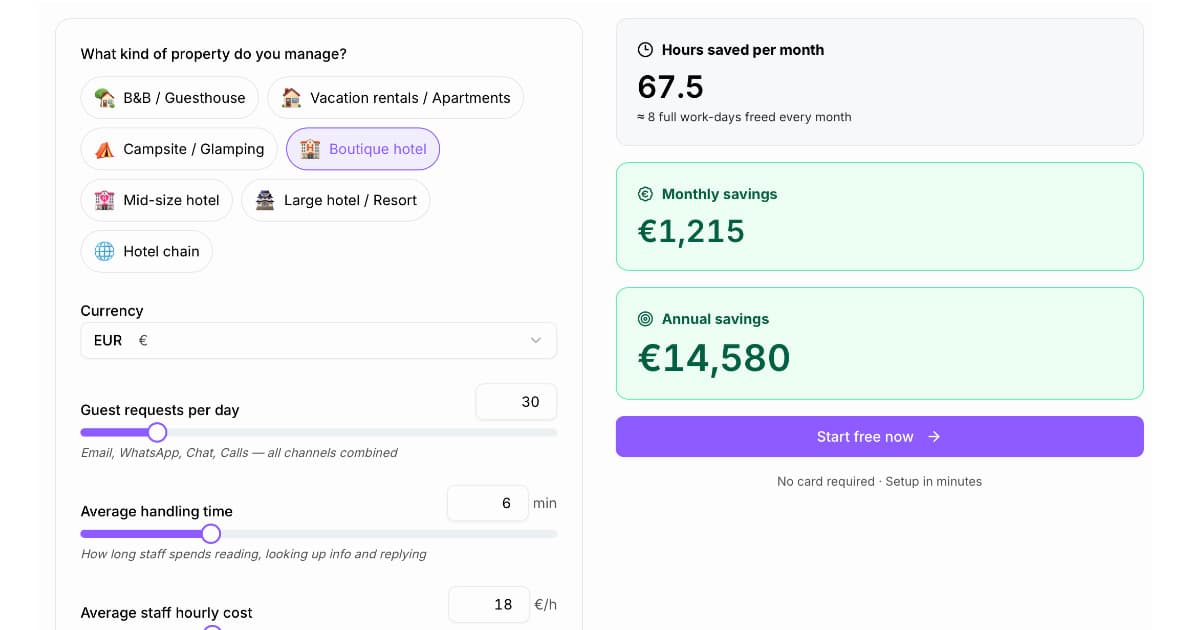
| 🏨 Boutique hotel | 30 | 6 min | 75% | 68 | €14,580 |
| 🏩 Mid-size hotel | 55 | 7 min | 70% | 135 | €30,807 |
| 🏯 Resort | 120 | 8 min | 60% | 288 | €72,576 |
| 🌐 Hotel chain | 100 | 7 min | 75% | 263 | €62,370 |
Even the smallest properties – a 4-room B&B in Tuscany, a tent-only campsite – recover the equivalent of more than two full work-days a month. The mid-size hotel? Almost 17 full work-days. That's not "marginal efficiency". That's the difference between hiring a junior receptionist or not.
👉 Run the calculator on your own numbers →
Two flavours of guest questions (why speed matters twice)
Not all guest questions are equal. They fall into two distinct categories – each with a different ROI logic.
1. Pre-booking inquiries (the chat on your website)
These are questions from people who haven't yet booked. They arrive via the chat widget on your website, OTA messages (Booking.com, Airbnb), and contact-form emails.
The pattern is brutal: conversion drops off a cliff with delay.
Reply within 5 minutes: ~50% of inquiries become bookings.
Reply within 1 hour: drops to ~30%.
Reply within 24 hours: drops to ~10%.
After 24 hours: the guest has already booked somewhere else.
Source: Skift and Phocuswright agree on the rough numbers – exact figures vary by segment but the curve is always the same.
An AI assistant on your website that answers basic questions instantly – "Do you have parking? Are pets allowed? What's the cheapest room next weekend?" – doesn't just save you time. It captures bookings that would otherwise vanish to the OTA the guest checks two minutes later.
A modern AI assistant also reads the sentiment of the conversation. If a guest's tone turns hesitant, frustrated, or hostile – or if they mention a problem, a complaint, or an objection that needs a human touch – the assistant doesn't just keep replying. It flags the conversation to you in real time via email or WhatsApp, with a summary of what's going on, so you can step in personally at exactly the right moment. The slow conversations that today get lost in the inbox become the ones you intercept first.
2. In-stay requests (the QR code in the room, the WhatsApp from guests)
These come from guests who are already in your property. Wifi password, restaurant hours, towel requests, "where's the closest pharmacy", "can I extend my checkout to 1 PM?".
A category that's often underestimated – but particularly powerful for B&Bs and vacation rentals – is practical troubleshooting. The washing machine that won't start, the dishwasher beeping at midnight, the air conditioner remote that doesn't respond, a blackout in the kitchen, the parking gate that won't open. Today these requests end up on the owner's mobile phone, often at the worst possible moment. A well-configured AI assistant can guide the guest step by step: "check the lint filter, restart the appliance by holding button X for 5 seconds, try the breaker on the left of the fuse box". Most of these scenarios get resolved without your phone ringing.
Here the math is different: you're not losing bookings (the guest is already there). You're losing review scores.
A guest who waits more than 30 minutes for a reply leaves an average review 0.4 stars lower than one who gets an immediate response.
On Booking.com and Google, a 0.4-star drop in average rating typically reduces conversion by 10—15%.
An AI assistant accessible via QR codes in the rooms and common areas means every in-stay question gets answered in seconds – even at 3 AM. Your staff stops being interrupted. Your reviews go up.
The double win
This is why the time-savings calculator only tells half the story. The hours you save are real and bankable, but the extra bookings won at the pre-booking stage and the extra review-driven bookings are an equally large second pile of money. We'll have a separate calculator for those – coming soon.
The 7 most automated request types (with realistic % by category)
If you're wondering "which questions, specifically, does the AI handle?" – here are the top categories ranked by automation rate, from easiest to hardest:
WiFi password and tech info – 99% automatable. The simplest possible request. AI replies in 2 seconds.
Check-in / check-out times – 95%. The single most-asked question in hospitality.
Property facilities (parking, breakfast, pool hours) – 90%. As long as your info is loaded into the assistant.
Local recommendations (restaurants, attractions) – 85%. AI can pull from your curated list of partners and Google data.
Late check-out / early check-in requests – 80%. Requires PMS integration to confirm availability – but most modern AI assistants do this automatically.
Reservation modifications – 65—75%. Date changes, room upgrades. Higher when the AI is connected to your PMS.
Complaints requiring empathy – 20—30%. The AI can acknowledge, gather details, and escalate, but a human takes over.
Notice the pattern: the more "factual" a question, the higher the automation rate. The more "human emotion" involved, the lower. That's not a flaw – it's by design.
When automation does NOT save time (the honest limits)
We're allergic to "AI does everything" pitches because they backfire when reality hits. Here's where you should NOT expect automation:
Personalised concierge requests. "I need a babysitter who speaks French for tomorrow afternoon" – a human in your team is faster and warmer.
Multi-step booking changes with edge cases. Group rooming lists, complex cancellation policies, special billing – let humans handle these.
Emotional complaints. A guest who's angry about a noisy room at midnight needs a human voice. The AI's job here is to acknowledge fast, gather context, and route to your phone in under 30 seconds – not to "solve" the complaint.
The first 4 weeks after launch. The AI needs to learn your property. Quality climbs steadily for the first month as you correct edge cases. Expect ~50% automation in week 1, ~75% by week 4.
The remaining 10—40% of requests that the AI doesn't automate fully are still partially helped: the AI summarises the conversation, suggests a reply, and routes to the right staff member with full context. Your team's average response time still drops.
Try it on your own numbers – the Hotel Time Savings Calculator
Reading averages is one thing. Plugging in your own numbers and seeing the result for your property is more useful.
Our free calculator takes 20 seconds:
Pick your property type (B&B, campsite, boutique, hotel, resort, chain, or vacation rental).
Pick your currency (EUR, USD, GBP, CHF, JPY, CNY, INR, BRL, RUB, SAR).
Adjust the daily requests, average handling time, hourly cost, and automation rate sliders.
See the live count of hours, monthly savings, and annual savings.
You can share the URL with your business partners – it carries your settings as query parameters, so you all see the same scenario.
👉 Open the Hotel Time Savings Calculator →
Frequently asked questions
How accurate are the automation rate estimates?
The 60—90% range comes from cross-referencing the HiJiffy 2024 Hotel Chatbot Benchmark, Phocuswright Hospitality AI 2024 report, and Reception24's own observations. The actual rate for your property will land somewhere in your category's range – the more standard your requests, the higher.
Do I need an existing PMS for this to work?
No. An AI assistant can deliver 60—70% automation without any PMS integration – just by knowing your property's static info (rooms, services, policies). Connecting it to your PMS unlocks the harder cases like booking changes, lifting automation to 80—90%.
How long does it take to set up?
Setup is typically 10—30 minutes for a small property. You connect your channels (email, WhatsApp, website chat), point the assistant at your website so it scrapes your existing info, and you're live. The first week is fine-tuning as you correct edge cases.
What does an AI assistant like Assistant24 cost?
Reception24's Assistant24 starts at €19/month. For a property with the typical volumes shown in the calculator, the investment pays back in under a week.
Can I share the calculator with my partners?
Yes – when you change the inputs, the URL automatically updates with your settings. Copy the address bar and send the link. Your partners will see the exact scenario you configured.
The bottom line
An AI front-desk assistant doesn't replace your team – it removes the repetitive 70—85% of their inbox so they can focus on the moments that actually matter: the personal welcome, the local tip, the small surprise that turns a guest into a returning one.
For a B&B that's about 18 hours a month. For a campsite, 53. For a resort, 288. In every case, it's enough to either hire less, do more with the same team, or finally have your evenings back.
The exact number for your property is a click away.